
Lean tools · Guide for supervisors and teams
What is 5S? The five steps, with examples from work and home
What Sort, Set in order, Shine, Standardise and Sustain mean, how to run a 5S event in your own area, the visual tools that make it stick, and how 5S is practised in Malaysia.
5S is a method for organising a workplace so that work flows and problems are easy to see. Its five steps come from Japanese words: Sort (Seiri), Set in order (Seiton), Shine (Seiso), Standardise (Seiketsu) and Sustain (Shitsuke). It is a foundation of lean and Lean Six Sigma, and Malaysia’s public sector knows it as Sisih, Susun, Sapu, Seragam and Sentiasa Amal.
What 5S means
5S is a systematic way to organise and maintain a workplace. It removes what is not needed, gives everything that is needed a fixed and visible place, keeps the area clean enough that abnormalities stand out, and turns those habits into a standard that people keep without being told.
The name comes from five Japanese words that each start with S. Each language has its own version, and Malaysian organisations often use the Malay terms from MAMPU’s public sector guide:
| Japanese | English | Malay (MAMPU) | In one line |
|---|---|---|---|
| Seiri | Sort | Sisih | Remove what is not needed |
| Seiton | Set in order | Susun | A marked place for everything that is needed |
| Seiso | Shine | Sapu | Clean, and inspect while cleaning |
| Seiketsu | Standardise | Seragam | Make the first three a written, visual routine |
| Shitsuke | Sustain | Sentiasa Amal | Keep the routine as a habit, checked by audit |
5S is often mistaken for housekeeping. Cleaning is only the third step. The point of 5S is that a tidy, standard workplace makes waste and problems visible: a missing tool, a leak, a pile of stock that should not be there, a document in the wrong tray. That is why lean organisations treat it as the base for everything else, from kanban to standard work.
The five steps, one at a time
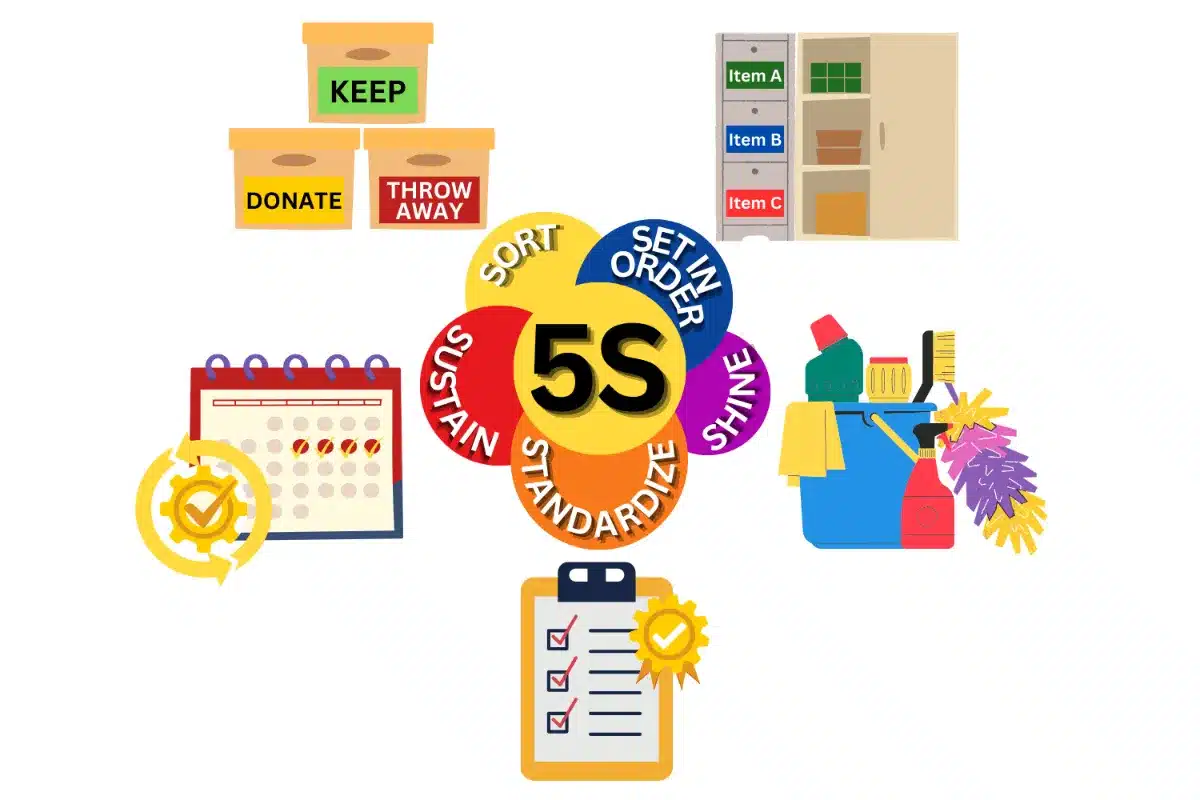
Sort (Seiri, Sisih)
Is everything in this area needed here, now?
Go through every item, including tools, materials, files, furniture and the shared drive. Keep what is used in this area; move what is used elsewhere; remove what is broken, expired or never used. Items nobody can decide on get a red tag and go to a holding area with a decision date. Done when: nothing in the area lacks a reason to be there.
Set in order (Seiton, Susun)
Can anyone find, use and return each item without searching?
Give every item a fixed, labelled home based on how often it is used: daily items within reach, weekly items nearby, rare items stored further away. Use floor markings, labels, shadow boards and colour codes so the right place is obvious. Done when: a new team member can find any item in seconds and can see at once if one is missing.
Shine (Seiso, Sapu)
Is the area clean, and are we inspecting while we clean?
Clean the area, equipment and tools, and use cleaning as an inspection: oil on the floor, a loose guard, a cracked hose or a printer jam is found sooner on a clean machine than on a dirty one. Assign areas and a schedule. Done when: cleaning is routine and abnormalities are reported, not just wiped away.
Standardise (Seiketsu, Seragam)
Is the way we sort, store and clean written down and visible?
Turn the first three steps into simple standards: a photo of how the area should look, a checklist, a cleaning schedule, labels that follow the same rules everywhere. One-point lessons (a single page with one picture and one instruction) work well on the shop floor. Done when: two people in different shifts keep the area the same way.
Sustain (Shitsuke, Sentiasa Amal)
Do we keep it up without a campaign?
Make 5S part of normal management: short daily checks by the team, a regular audit with a score, managers who look at the area on their gemba walks, and time to fix what the audit finds. This is the hardest step, and the reason many 5S programmes fade after the first big clean. Done when: the area still meets the standard months later without a special event.
5S and safety: is there a sixth S?
Many organisations, especially in construction, manufacturing and healthcare, call their programme 6S and add Safety as a sixth step: identifying hazards while sorting and setting in order, marking safe walkways and forklift routes, labelling hazardous materials and checking guards and protective equipment during Shine. Researchers have proposed ways to build occupational safety and health into 5S in this way (Jiménez and colleagues, 2019).
Others argue that a well-run 5S already includes safety, because each step removes hazards. Either way, safety should never be treated as an extra; if your sites track safety separately, 6S makes that explicit.
5S in Malaysia
5S is unusually well known in Malaysia because the public sector adopted it widely. MAMPU, the government’s administrative modernisation unit, published a 5S practice guide for public agencies in 2010, using the Malay terms Sisih, Susun, Sapu, Seragam and Sentiasa Amal. Public-sector 5S has since been rebranded as EKSA (Ekosistem Kondusif Sektor Awam, a conducive public sector ecosystem), with 5S still at its core.
The Malaysia Productivity Corporation (MPC) audits and certifies organisations under its Quality Environment Practices (5S) certification. Public bodies such as skills training centres and port authorities have reported receiving it, and many private manufacturers use the same framework.
If your organisation already runs EKSA or an MPC 5S programme, the steps in this guide are the same; the difference in a lean or Lean Six Sigma setting is the purpose. 5S is not the goal; it is the stable, visible base that makes flow, kanban and problem-solving possible.
Where 5S fits in Lean Six Sigma
In lean, 5S is usually one of the first tools a site puts in place, because visual management, standard work and pull systems all depend on a workplace where the normal state is obvious. In a Lean Six Sigma DMAIC project, 5S appears mainly in the Improve phase, as a quick fix for search time, motion and errors, and in the Control phase, where its standards and audits hold the gains.
5S also pairs naturally with the PDCA cycle: each 5S audit is a Check, and each fix to the standard is an Act. It is covered in our Lean Six Sigma Yellow Belt syllabus, and it is a full module of our Kaizen Yellow Belt course.
Visual tools for 5S
These four tools do most of the work in Set in order and Standardise. Each one shows at a glance whether the area is in its normal state.
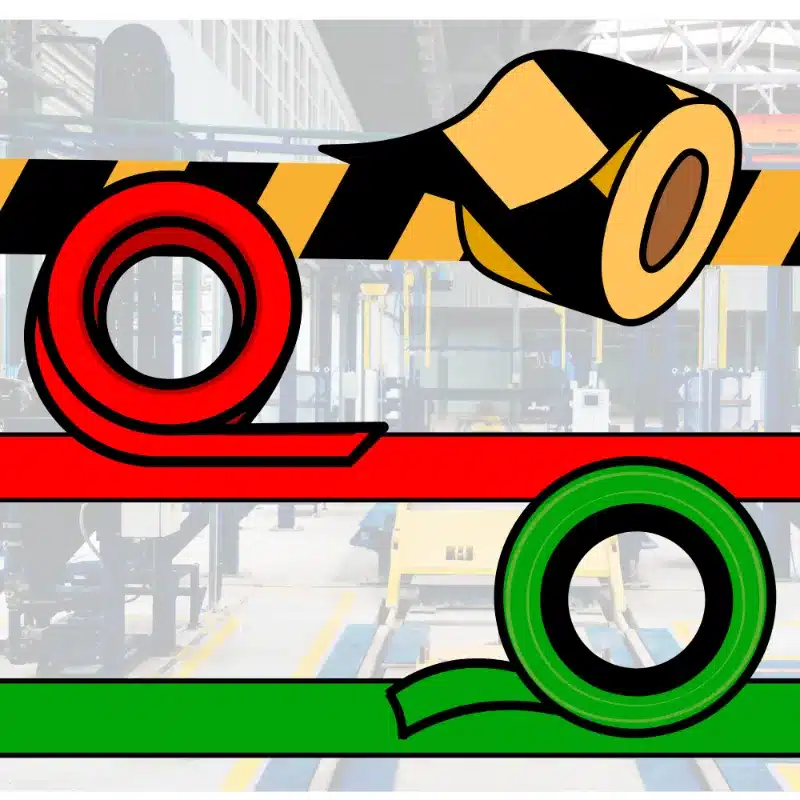 Floor marking tape. Marks walkways, storage spots and hazard zones. Agree one colour code for the whole site. |
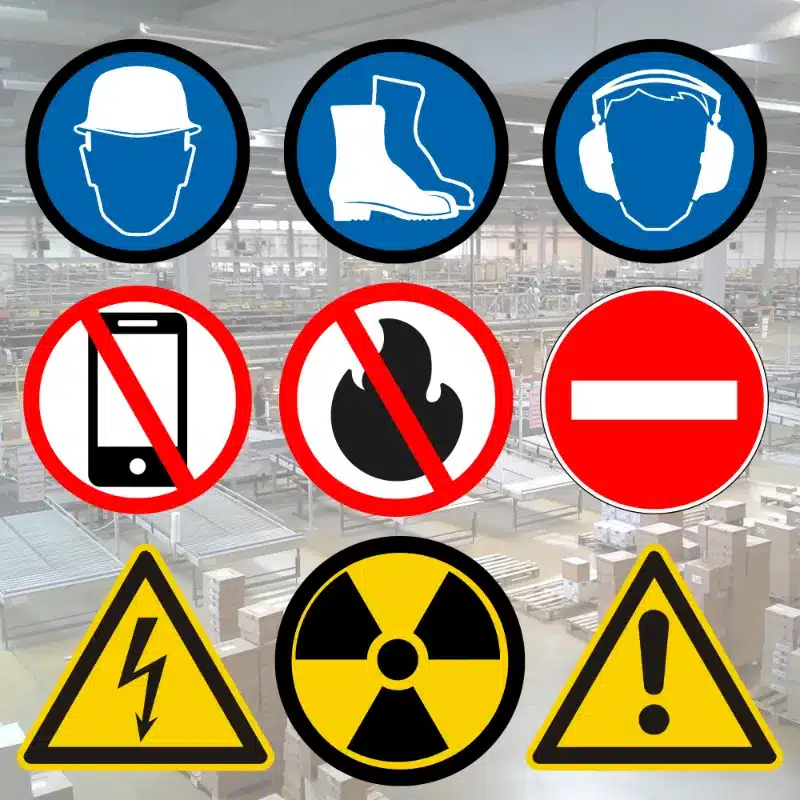 Labels and signs. Name every location and warn of every hazard, using standard symbols. |
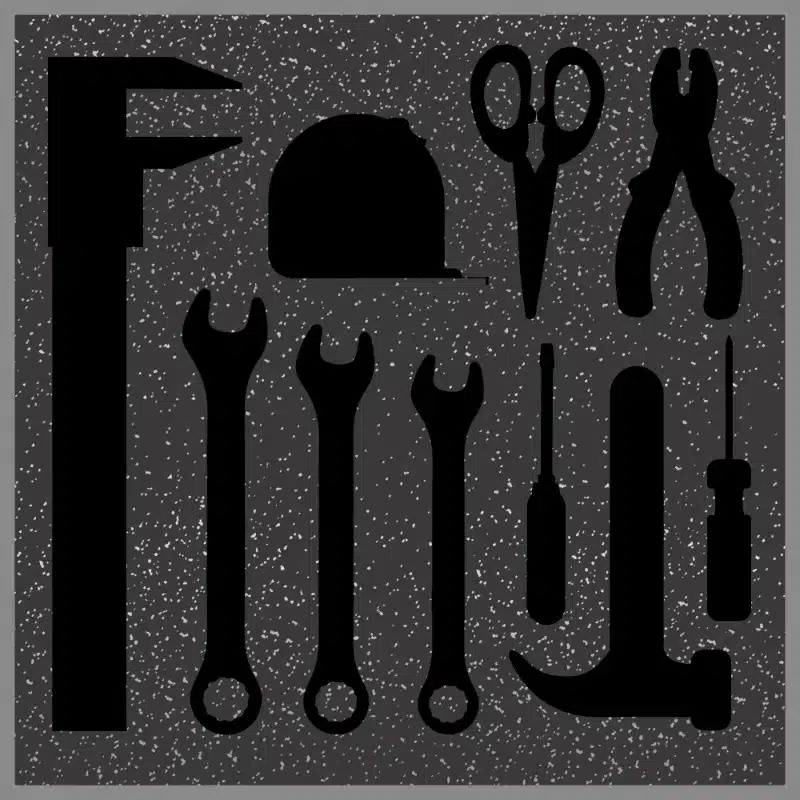 Shadow boards and tool foam. An outline for each tool, so a missing one is obvious. |
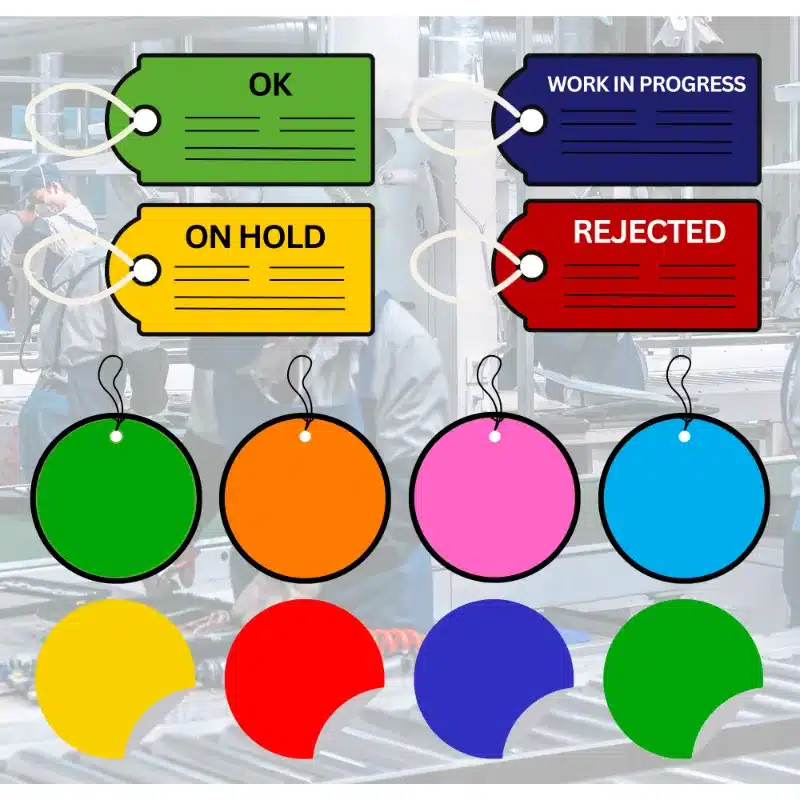 Coloured tags. Red tags for items under review in Sort; status tags such as OK, On hold and Rejected for material. |
How to run a 5S event in your area
- Pick one pilot area that people can see, such as a store, a workstation or a shared office, and a team of the people who work there.
- Take “before” photos from fixed points, and agree what “good” will look like.
- Sort in one session. Red-tag doubtful items, move them to a holding area, and set a decision date (two weeks is common).
- Set in order: decide homes by frequency of use, then mark, label and outline them.
- Shine: clean deeply once, list every abnormality found, and fix or log each one.
- Standardise: post the “after” photo, the checklist and the cleaning roster at the area.
- Sustain: start a short daily check by the team and a monthly audit with a score, and review the scores at a team meeting.
A simple monthly audit scores each S from 1 (not started) to 5 (fully in place) for one area. The scores below are invented to show the format, not results from a real site.
| Step | What the auditor checks | Score |
|---|---|---|
| Sort | No unneeded items; holding area cleared by its date | 4 |
| Set in order | Every item labelled; shadow board complete; nothing on the floor | 4 |
| Shine | Clean; abnormalities found during cleaning are logged | 3 |
| Standardise | Photo standard, checklist and roster posted and current | 3 |
| Sustain | Daily checks signed; last audit actions closed | 2 |
| Total | Out of 25 | 16 |
The lowest score is the next improvement. Here, Sustain is weakest, so the team’s action is to put the daily check into the shift handover rather than to clean again.
Examples of 5S at work and at home
- Production line: only the parts and tools for today’s job at the station; tools on a shadow board; floor marked for material in, work in progress and finished goods.
- Warehouse: fast-moving items near dispatch; locations labelled; slow and obsolete stock red-tagged for a decision.
- Office and shared drive: one folder structure and naming rule for the team; old drafts archived; desks clear at the end of the day. This “digital 5S” often saves more time than the physical one.
- Hospital or clinic: supply rooms with labelled shelves and minimum levels, so staff spend less time searching for consumables.
- At home: sort the kitchen into keep, donate and throw away; give daily items a place near where they are used; clean as you go; agree a weekly reset with the family. The same five steps, smaller scale.
Published studies have looked at 5S in settings as different as hospitals, automotive plants and production companies, including its effect on patient waiting time and on working conditions and safety (see the sources below).
Common mistakes
- Treating 5S as a cleaning day.A one-off clean-up without standards and audits is back to the old state within weeks.
- Skipping Sort.Labelling and organising things nobody needs only makes the clutter neater. Remove first.
- Doing it to people, not with them.If the team that works in the area does not decide where things go, the layout will not last.
- Audits with no follow-up.A score nobody acts on teaches people that 5S does not matter. Close every audit action.
- Stopping at 5S.A tidy area is the start. Use the visibility it creates to find and fix the causes of waste, with tools such as PDCA and kanban.
FAQ
What does 5S stand for?
Sort, Set in order, Shine, Standardise and Sustain, from the Japanese Seiri, Seiton, Seiso, Seiketsu and Shitsuke. In Malay they are Sisih, Susun, Sapu, Seragam and Sentiasa Amal.
What is 5S in Lean Six Sigma?
5S is a lean tool used to create a stable, visual workplace. In Lean Six Sigma projects it is used mainly in the Improve phase to remove search time, motion and errors, and in the Control phase to hold the gains through standards and audits.
Is 5S the same as housekeeping?
No. Cleaning is only the third step. 5S also removes what is not needed, gives everything a fixed and visible place, and turns this into standards and habits, so that problems become visible.
What is 6S?
6S is 5S with Safety added as a sixth step: hazards are identified and controlled as part of sorting, organising and cleaning the workplace.
Who certifies 5S in Malaysia?
The Malaysia Productivity Corporation (MPC) audits and certifies organisations under its Quality Environment Practices (5S) certification. In the public sector, 5S practice is now part of EKSA (Ekosistem Kondusif Sektor Awam).
Key takeaway
5S is not a clean-up; it is a standard that makes the normal state of a workplace obvious, so that anything abnormal stands out. Sort before you organise, inspect while you clean, write the standard down, and keep auditing until the habit holds.
5S training in Malaysia
Learn 5S as part of Kaizen Yellow Belt
Our Kaizen Yellow Belt course covers the 5S system as a full module, alongside the other kaizen tools your team needs to run improvement in its own area. It runs as public classes and in-house.
Want a 5S programme run for your site only? See in-house training.
Related reading
Sources
- United States Environmental Protection Agency. Lean Thinking and Methods: 5S. Accessed 11 October 2026.
- MAMPU, Prime Minister’s Department (2010). Panduan Amalan 5S Sektor Awam (public sector 5S guide), first printing 2010.
- Universiti Kebangsaan Malaysia (2023). Garis Panduan EKSA UKM (EKSA as the rebranding of public sector 5S practice).
- The Borneo Post (9 August 2012). PPKS receives 5S certification from MPC.
- Osada, T. (1991). The 5S’s: Five Keys to a Total Quality Environment. Asian Productivity Organization.
- Hirano, H. (1995). 5 Pillars of the Visual Workplace: The Sourcebook for 5S Implementation. Productivity Press.
- Jiménez, M., Romero, L., Fernández, J., Espinosa, M. M., and Domínguez, M. (2019). Extension of the Lean 5S methodology to 6S with an additional layer to ensure occupational safety and health levels. Sustainability, 11(14), 3827.
- Ishijima, H., Eliakimu, E., and Mshana, J. M. (2016). The “5S” approach to improve a working environment can reduce waiting time. The TQM Journal, 28(4), 664 to 680.
- Veres, C., Marian, L., Moica, S., and Al-Akel, K. (2018). Case study concerning 5S method impact in an automotive company. Procedia Manufacturing, 22, 900 to 905.
- Kabiesz, P., and Bartnicka, J. (2019). 5S system as a manner for improving working conditions and safety of work in a production company. Multidisciplinary Aspects of Production Engineering, 2(1), 496 to 507.
Start today
Learn Lean Six Sigma at your own pace
Each belt is a self-paced online course with quizzes and a certification exam. 12 months' access, start any day.
 Self-paced onlineLean Six Sigma Yellow BeltA first grounding in Lean, Six Sigma and DMAICStart any day · 12 months’ access · Certification exam includedRM2,088
 Self-paced onlinePopularLean Six Sigma Green BeltRun improvement projects with the core DMAIC toolsStart any day · 12 months’ access · Certification exam includedRM3,788
 Self-paced onlineBest sellerLean Six Sigma Black BeltLead larger projects with the full DMAIC toolkitStart any day · 12 months’ access · Certification exam includedRM5,088
Compare the three online courses · Self-paced courses are not HRD Corp claimable. For a claimable option, see live virtual courses.
3 Comments