
Lean tools · Guide for supervisors and managers
Gemba walk: what to look for on the floor, the questions to ask, and a checklist
What a gemba walk is and is not, how to prepare, walk and follow up, the questions that work, a checklist you can print, and what the evidence says about leadership walks.
A gemba walk is a management practice in which a leader goes to the place where the work is done, the gemba (Japanese for “actual place”), to understand the current situation through direct observation and questions before taking action. It is not an inspection or a tour. A good walk follows one process, asks open questions about its purpose, process and people, changes nothing on the spot except safety hazards, and ends with follow-up on what was learned.
What a gemba walk is
The Lean Enterprise Institute defines the gemba walk as a management practice for grasping the current situation through direct observation and inquiry before taking action. Gemba is Japanese for “actual place”; in lean it means the place where value is created: the production line, the warehouse, the claims desk, the ward.
The idea comes from the Toyota principle of genchi genbutsu, “go and see”: decisions about the work should be based on what is actually happening at the work, not on reports, averages or assumptions made in a meeting room. Toyota’s former chairman Fujio Cho summarised it as “Go see, ask why, show respect”, as recalled by John Shook of the Lean Enterprise Institute.
A gemba walk is how leaders and supervisors understand the work, coach the people doing it, and find the problems worth solving. It is a habit, not an event.
What a gemba walk is not
| Practice | Purpose | How a gemba walk differs |
|---|---|---|
| Audit or inspection | Check compliance against a standard and score it | A walk is for learning and coaching, not for grading people. A 5S audit is a separate routine. |
| Factory or site tour | Show visitors the operation | A walk follows one process closely and asks questions; a tour covers everything lightly. |
| “Management by walking around” | Be visible and approachable | A walk has a stated purpose, a defined process to follow and follow-up actions. |
| Firefighting visit | Fix today’s crisis | A walk happens when nothing is on fire, so normal work and its problems can be seen. |
How to run a gemba walk
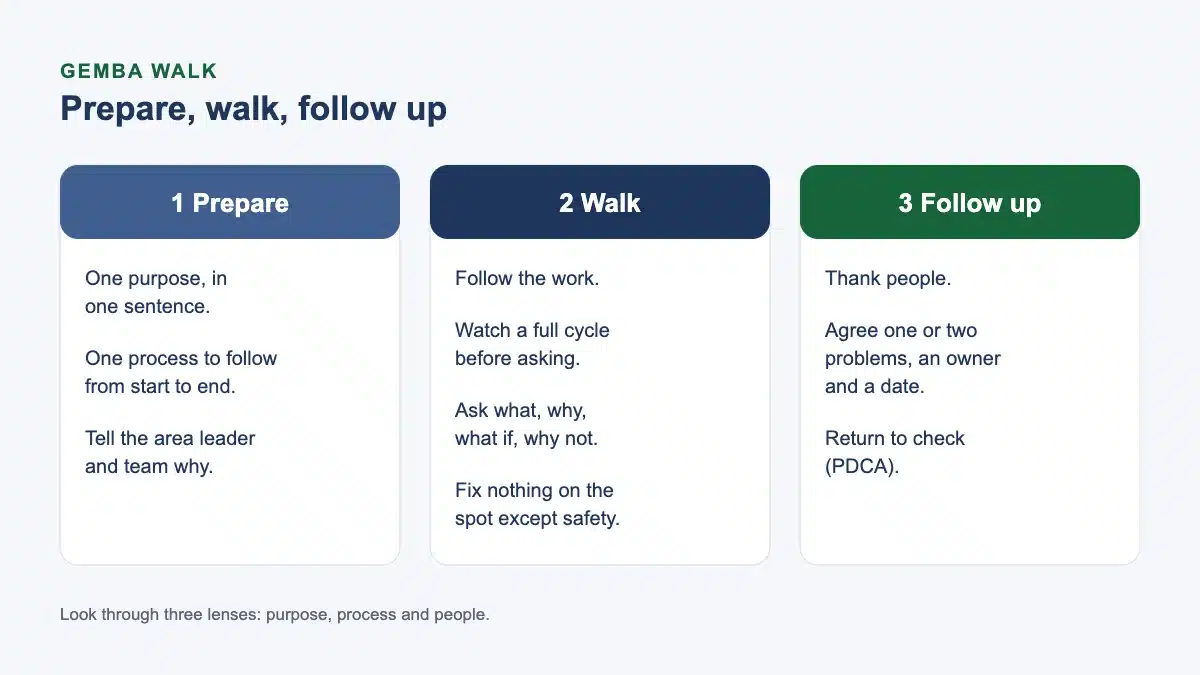
Prepare
Why am I going, and what will I follow?
Choose one purpose for the walk (for example, why orders wait before packing, or why the morning shift misses its first-hour target) and one process, product or customer request to follow from start to end. Tell the area leader and the team you are coming and why, so the walk is not mistaken for an inspection.
Walk
What is actually happening, and why?
Follow the work, not the org chart. Watch at least one full cycle at each step before asking anything. Ask open questions in order: what is happening, why, what if, and why not. Take notes of what you see and hear, including waiting, searching, rework and workarounds. Do not fix things on the spot or hand out instructions, except to stop an unsafe act.
Follow up
What will I do to help?
Thank the people you spoke to. Share what you saw with the area leader, agree one or two problems to work on, and give them an owner and a date. Return to check. Problems raised on a walk and never followed up teach people that walks are for show.
Questions to ask on a gemba walk
John Shook suggests looking at the work through three lenses, purpose, process and people, and asking questions in a sequence: what is happening, why, what if, and why not. Diagnose only after you understand the situation.
| Lens | Questions |
|---|---|
| Purpose | Who is the customer of this step? What do they need from it? How do you know if today is a good day? |
| Process | Can you walk me through what you just did? What happens when an input is missing or wrong? Where does work wait? How do you know the standard? What got in your way today? |
| People | What would make this job easier? What problem have you raised before that is still there? Who helps when you get stuck? What have you improved recently? |
Avoid questions that blame (“Why didn’t you follow the procedure?”) or that only have a yes or no answer. Ask about the process, not the person.
Gemba walk checklist
- Purpose written down in one sentence before you go.
- One process chosen to follow from start to end.
- Area leader and team told when and why you are coming.
- Safety rules and PPE for the area checked and followed.
- At least one full cycle observed at each step before asking.
- Open questions asked about purpose, process and people.
- Notes taken on waiting, searching, rework, workarounds and visual controls (are the standard, the board and the status clear at a glance?).
- Nothing changed on the spot except unsafe conditions.
- People thanked before you leave.
- One or two problems agreed with the area leader, each with an owner and a date.
- Return visit planned to check the actions, using the PDCA cycle.
How often to walk
There is no single rule. A common pattern is that team leaders are at the gemba every shift, area managers walk several times a week, and senior leaders walk on a regular, scheduled basis, for example weekly. Regular, shorter walks with follow-up are worth more than an occasional long one. Put the walk in the calendar so it survives busy weeks.
Gemba walks in offices and hospitals
The gemba is wherever the value is created, so the practice works outside factories:
- Offices and shared services: follow one request, invoice or ticket through every hand-off. The work is often invisible in systems, so ask people to show you their screen, queue and workarounds. See our guide to Lean Six Sigma in BPO and shared services.
- Warehouses: follow an order from pick to dispatch, and watch where it waits; a kanban board makes queues visible.
- Hospitals and clinics: follow a patient’s journey or a medication from order to administration. Healthcare has its own long-standing form of leadership walk, safety WalkRounds, with a body of research behind it.
What the evidence says about leadership walks
Most writing on gemba walks is practitioner experience. The most studied relative is the leadership safety walk in healthcare. A review of 43 studies by Singer and Tucker (2014) found that 33 reported positive effects, but these were mostly single-site studies of organisations that chose to adopt walks; more rigorous studies were less favourable, and two found safety climate declined in the units that did walks.
The review found that walks most often surface equipment, supply and facility problems, and that results depend on how they are run: genuine senior commitment, involvement of middle managers, and above all follow-up on the issues raised. Walks used for surveillance, or treated as an end in themselves, frustrated frontline staff. Participation also mattered: in one study of 49 hospitals, safety climate was higher where at least 60% of staff reported taking part, yet only 7.4% of units reached that level.
The practical lesson for any gemba walk is the same: the walk is only as good as what happens after it.
A production manager walks the packing line with the purpose “why do orders wait before packing?”. She follows one order, sees cartons arrive in mixed sizes and operators searching for the right box, and asks why. Operators explain that the carton supplier changed and the new sizes are not labelled. She agrees one action with the team leader (label and re-slot the cartons by size, a 5S fix) and returns a week later to see whether waiting has fallen. The scenario is invented to show the method, not a client result.
Common mistakes
- Turning the walk into an inspection.Scoring people or pointing out faults makes the team hide problems, which is the opposite of the purpose.
- Fixing things on the spot.Instructions given in passing bypass the team leader and rarely address the cause. Note it, agree it, follow it up.
- Walking without a purpose.A walk that tries to see everything sees nothing in depth. Follow one process.
- Talking more than watching.Watch a full cycle before asking. Most of what you need to see is visible if you wait.
- No follow-up.The research on leadership walks is clear: issues raised and not closed damage trust.
FAQ
What is a gemba walk?
A management practice in which a leader goes to the place where the work is done to understand the current situation through direct observation and questions before taking action. Gemba is Japanese for actual place.
What questions should I ask on a gemba walk?
Open questions about purpose, process and people, asked in order: what is happening, why, what if, and why not. For example: can you walk me through what you just did, where does work wait, and what got in your way today?
What is the difference between a gemba walk and an audit?
An audit checks compliance against a standard and scores it. A gemba walk is for learning and coaching: the leader observes, asks questions and agrees follow-up actions, without grading people.
How often should managers do gemba walks?
There is no fixed rule. A common pattern is team leaders every shift, area managers several times a week and senior leaders on a regular schedule. Regular short walks with follow-up are worth more than occasional long ones.
Can you do a gemba walk in an office?
Yes. The gemba is wherever value is created. In an office, follow one request, invoice or ticket through every hand-off and ask people to show you their screens, queues and workarounds.
Key takeaway
Go to where the work is done, follow one process, watch before you ask, ask about purpose, process and people, fix nothing on the spot except safety, and always follow up. The follow-up is what turns a walk into improvement.
Lean training in Malaysia
Build lean habits in your team
Our Lean programmes, including Kaizen Yellow Belt (with its 5S module) and Value Stream Mapping, teach the tools that make gemba walks productive, as public classes and in-house.
Training supervisors and managers from one site? See in-house training.
Related reading
Sources
- Lean Enterprise Institute. Gemba walk (Lean lexicon). Accessed 12 October 2026.
- Shook, J. (2023, first published 2011). How to go to the gemba: go see, ask why, show respect. Lean Enterprise Institute.
- Womack, J. P. (2013). Gemba Walks, 2nd edition. Lean Enterprise Institute.
- Singer, S. J., and Tucker, A. L. (2014). The evolving literature on safety WalkRounds: emerging themes and practical messages. BMJ Quality & Safety, 23(10), 789.
Start today
Learn Lean Six Sigma at your own pace
Each belt is a self-paced online course with quizzes and a certification exam. 12 months' access, start any day.
 Self-paced onlineLean Six Sigma Yellow BeltA first grounding in Lean, Six Sigma and DMAICStart any day · 12 months’ access · Certification exam includedRM2,088
 Self-paced onlinePopularLean Six Sigma Green BeltRun improvement projects with the core DMAIC toolsStart any day · 12 months’ access · Certification exam includedRM3,788
 Self-paced onlineBest sellerLean Six Sigma Black BeltLead larger projects with the full DMAIC toolkitStart any day · 12 months’ access · Certification exam includedRM5,088
Compare the three online courses · Self-paced courses are not HRD Corp claimable. For a claimable option, see live virtual courses.
1 Comment