
Lean tools · Guide for teams and the shop floor
What is kanban? Meaning, boards, cards and Toyota’s six rules
How kanban works on a production line and on a team board, how to set one up, how many cards you need, and the rules that keep it from turning into another to-do list.
Kanban is a pull system that uses visual signals to control work. In a factory, a kanban card (the Japanese word means “signboard”) authorises a process to make or move a set quantity of parts only after the next process has used them. In offices, a kanban board shows work as cards moving through columns, with a limit on how much work is in progress at once.
What kanban means
The Lean Enterprise Institute defines a kanban as “a signaling device that gives authorization and instructions for the production or withdrawal of items” in a pull system. The word is Japanese for “sign” or “signboard”.
The idea comes from the Toyota Production System. Toyota’s own company history records that it introduced a “supermarket method” in 1954: each process collected only the parts it needed from the process before it, the way a shopper takes goods from a shelf that is then restocked. Once a production instruction card was added, the method evolved into the kanban system, the main tool of just-in-time production, which is one of the two pillars of the Toyota Production System.
Today the word is used in two related ways:
- Kanban in production: a card, bin or electronic signal that tells a process what to make or move, and how many, only when the next process has used stock. This stops overproduction, the waste Taiichi Ohno considered the worst.
- Kanban for knowledge work: a visual board where each task is a card that moves through columns such as To do, Doing and Done, with limits on how many tasks can be in progress at once. Software, HR, finance, customer service and BPO teams use it to see bottlenecks and finish work faster.
Both rest on the same principle: work is pulled by real demand, not pushed by a plan or a forecast.
The kanban board
A kanban board makes the flow of work visible. Each column is a stage of the process and each card is one piece of work. The simplest board has three columns:
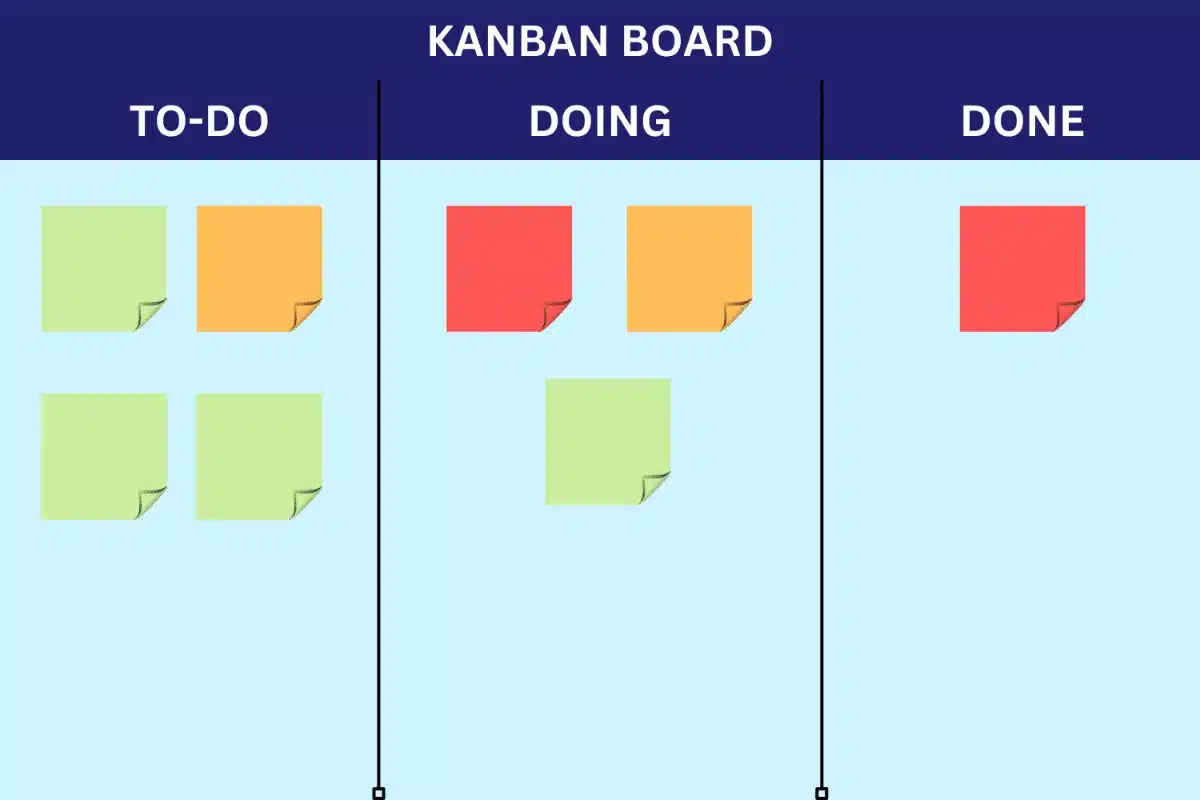
- To do: work that has been agreed but not started.
- Doing: work in progress (WIP). This column has a limit, for example no more than three cards for a team of three.
- Done: finished work, which shows the team what it has delivered.
The work-in-progress limit is what makes a board a kanban board rather than a to-do list. When the Doing column is full, nobody starts anything new; the team helps finish what is already there. That is the pull: new work enters only when there is capacity for it. A blocked card, shown in a different colour, is a signal to swarm the problem rather than start something else.
Teams add columns that match their real process, for example Backlog, Analyse, Build, Review and Done for a project team, or New ticket, In progress, Waiting for customer and Resolved for a support team. Whiteboards and sticky notes work well for a team in one room; tools such as Jira, Trello, Asana or Microsoft Planner do the same job online.
How to set up a kanban board in five steps
- Map the current process. Write down the stages work really goes through today, not the ideal. Each stage becomes a column.
- Put every piece of work on a card. One task, order or request per card, with an owner and a due date where it matters. Use colour for type or priority.
- Set work-in-progress limits. Start with roughly one card per person in each active column, then adjust. A limit that is never reached is too high.
- Agree the rules. Decide when a card may move to the next column (what “done” means for each stage) and write it at the top of the column.
- Review the board daily and improve it monthly. A short stand-up at the board shows what is blocked. Once a month, look at how long cards take to cross the board and remove the biggest delay, using a PDCA cycle.
Individuals can run the same board for their own work. Jim Benson and Tonianne DeMaria Barry called this personal kanban in their 2011 book of the same name, and reduced it to two rules: visualise your work, and limit your work in progress.
Kanban cards in manufacturing: production and withdrawal
On a production line, the kanban travels with the parts. The Lean Enterprise Institute describes two main types:
| Type | What it authorises | Where it travels |
|---|---|---|
| Production kanban | An upstream process to make a specific part, in a specific quantity, for the downstream process | Stays between the producing process and its outbound stock point |
| Withdrawal (conveyance) kanban | A material handler to move a specific quantity of parts from the upstream stock point to the downstream process | Travels between the two processes with the container |
In a two-card system both cards are used. When the downstream workstation starts a container of parts, its withdrawal card goes back to fetch a replacement container from the upstream stock point. When that container is taken, its production card is removed and placed on the upstream process’s board, which is the only instruction to make more. Nothing is made or moved without a card, so stock between the two processes can never exceed the number of cards in circulation.
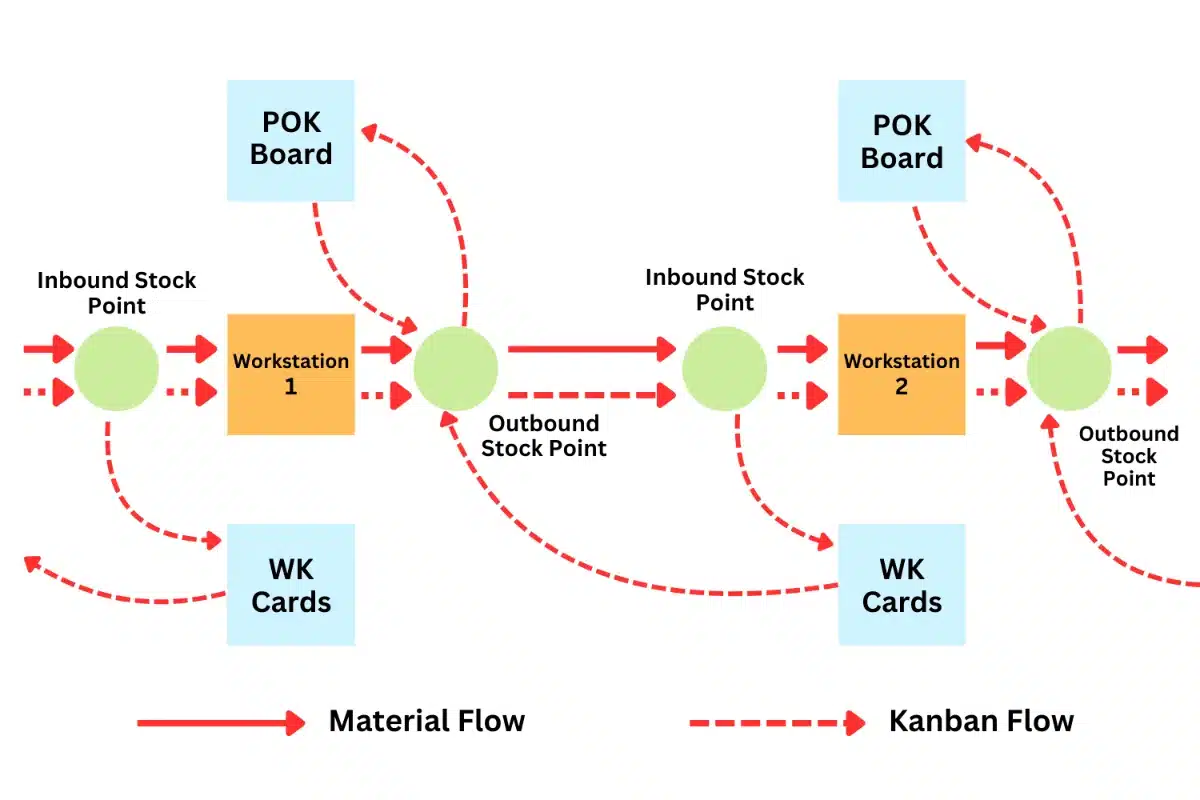
Some plants run a single-card system, where one card does the work of both signals. It is simpler, and is usually used where the two processes sit close together and parts can move as soon as they are made. Researchers have documented many other variations, including electronic kanban (e-kanban) signals sent through an ERP system, supplier kanban for purchased parts, and signal kanban for processes that run in batches.
Kanban is one part of a wider flow design. To decide where pull and supermarkets belong in your process, first map the whole flow with value stream mapping, and keep the stock points orderly with 5S.
Toyota’s six rules of kanban
Taiichi Ohno, the Toyota executive who built the system, set out six rules for using kanban in Toyota Production System: Beyond Large-Scale Production (1988). Kanban only works if all six are followed:
- The later process picks up the number of items shown on the kanban from the earlier process.
- The earlier process produces items in the quantity and sequence shown on the kanban.
- No items are made or moved without a kanban.
- A kanban is always attached to the goods.
- Defective products are not sent to the next process, so what moves forward is 100% good.
- Reducing the number of kanbans increases their sensitivity. Fewer cards mean less stock to hide problems, so problems surface and get fixed.
Rules 5 and 6 are the ones most often skipped. Without rule 5, a pull system simply moves defects faster. Without rule 6, kanban becomes a way to manage a fixed level of inventory instead of a way to keep reducing it.
The Kanban Method for office and knowledge work
David J. Anderson adapted kanban for software teams in the 2000s, and the idea spread to other knowledge work. Kanban University now describes the Kanban Method with four principles and six general practices.
| Principles | General practices |
|---|---|
| Start with what you do now | Visualise the work, the workflow and the business risks |
| Agree to pursue incremental, evolutionary change | Limit work in progress |
| Respect the current process, roles, responsibilities and titles | Manage flow |
| Encourage acts of leadership at all levels | Make policies explicit |
| Implement feedback loops | |
| Improve collaboratively, evolve experimentally |
The first principle is the practical difference from many other methods: kanban does not ask you to reorganise the team first. You put today’s process on a board and improve it step by step. That makes it a good fit for service operations, such as the BPO and shared services teams that handle a steady flow of tickets and transactions.
What kanban improves
- Less overproduction and inventory: nothing is made before it is needed, so stock and floor space fall.
- Shorter lead time: with less work queued, each item spends less time waiting. Our guide to takt time, cycle time and lead time shows how to measure it.
- Problems become visible: a blocked card or an empty container shows exactly where flow stopped.
- Fewer half-finished tasks: work-in-progress limits reduce switching between tasks.
- Self-managing replenishment: operators and material handlers act on the signal without waiting for a schedule.
Worked example: how many kanban cards do you need?
An electronics assembly cell in Penang uses 400 brackets a day from an in-house stamping press. Brackets move in containers of 50. From the moment a container is emptied, it takes half a day to collect the card, stamp a new batch and deliver it back to the cell. The team adds a 10% safety allowance while the system is new. The figures are invented to show the method; they are not results from a real company.
| Demand during the replenishment time | 400 brackets a day × 0.5 day = 200 brackets |
|---|---|
| Add the safety allowance | 200 × 1.10 = 220 brackets |
| Divide by the container quantity | 220 ÷ 50 = 4.4 |
| Round up | 5 cards (5 containers of 50 = at most 250 brackets between the press and the cell) |
Once the loop runs smoothly, Toyota’s sixth rule applies: take one card out. If the cell never runs short with four cards, the extra stock was hiding nothing. If it does run short, the shortage points to the real problem, perhaps a long die change on the press, and fixing that is the improvement.
Common mistakes
- No limit on work in progress.A board without limits is a to-do list on a wall. The limit is what creates pull.
- Cards on the wall, production still pushed.If the press still runs to a weekly forecast, the cards are decoration. Production must start only when a card arrives.
- Passing defects forward.Pull with defective parts only speeds up the problem. Fix quality at the source first (Toyota’s fifth rule).
- Too many columns and too much detail.A board nobody can read in ten seconds stops being used. Keep only the stages that change who works on the item.
- Never reviewing the numbers.Card counts and limits set on day one should fall over time. If they never change, the system is not improving.
FAQ
What does kanban mean?
Kanban is Japanese for “sign” or “signboard”. In lean production it is a signal, usually a card, that authorises a process to make or move a set quantity of items only when the next process needs them.
What are the six rules of kanban?
Set out by Taiichi Ohno: the later process picks up what the kanban shows; the earlier process produces in the quantity and sequence shown; nothing is made or moved without a kanban; a kanban always stays with the goods; defective products are never sent on; and reducing the number of kanbans makes the system more sensitive to problems.
What does a production kanban authorise a worker to do?
A production kanban authorises the upstream process to make the specific item, in the specific quantity, shown on the card, for the downstream process. A withdrawal kanban authorises moving that quantity from the upstream stock point to the downstream process.
What is the difference between a single-card and a two-card kanban system?
A two-card system uses separate withdrawal and production cards, so moving parts and making parts are controlled separately. A single-card system uses one card for both signals and is simpler; it suits processes that sit close together.
What is the difference between kanban and Scrum?
Scrum works in fixed sprints of one month or less, with three defined accountabilities: Product Owner, Scrum Master and Developers. Kanban has no fixed iterations and no new roles: work flows continuously, controlled by work-in-progress limits, starting from the process the team already has.
Key takeaway
Kanban is not the cards or the board; it is the rule that work starts only when the next step pulls it. Limit work in progress, never pass on defects, and keep reducing the number of cards until problems have nowhere to hide.
Lean training in Malaysia
Design pull and kanban on your own process
Our Value Stream Mapping course takes your team from mapping the current flow to designing a future state with pull, supermarkets and kanban. It runs as public classes and in-house for your plant.
Want it run for your team only? See in-house Lean Six Sigma training.
Related reading
Sources
- Lean Enterprise Institute. Kanban (Lean Lexicon). Accessed 11 October 2026.
- Toyota Motor Corporation. 75 Years of Toyota: modernisation of facilities (the supermarket method and the kanban system). Accessed 11 October 2026.
- Ohno, T. (1988). Toyota Production System: Beyond Large-Scale Production. Productivity Press.
- Kanban University. The Kanban Method: principles and general practices. Accessed 11 October 2026.
- Benson, J., and DeMaria Barry, T. (2011). Personal Kanban: Mapping Work, Navigating Life. Modus Cooperandi Press.
- Schwaber, K., and Sutherland, J. (2020). The Scrum Guide.
- Hopp, W. J., and Spearman, M. L. (2004). To pull or not to pull: what is the question? Manufacturing & Service Operations Management, 6(2), 133 to 148.
- Junior, M. L., and Godinho Filho, M. (2010). Variations of the kanban system: literature review and classification. International Journal of Production Economics, 125(1), 13 to 21.
- Naufal, A., Jaffar, A., Yusoff, N., and Hayati, N. (2012). Development of kanban system at local manufacturing company in Malaysia: case study. Procedia Engineering, 41, 1721 to 1726.
Start today
Learn Lean Six Sigma at your own pace
Each belt is a self-paced online course with quizzes and a certification exam. 12 months' access, start any day.
 Self-paced onlineLean Six Sigma Yellow BeltA first grounding in Lean, Six Sigma and DMAICStart any day · 12 months’ access · Certification exam includedRM2,088
 Self-paced onlinePopularLean Six Sigma Green BeltRun improvement projects with the core DMAIC toolsStart any day · 12 months’ access · Certification exam includedRM3,788
 Self-paced onlineBest sellerLean Six Sigma Black BeltLead larger projects with the full DMAIC toolkitStart any day · 12 months’ access · Certification exam includedRM5,088
Compare the three online courses · Self-paced courses are not HRD Corp claimable. For a claimable option, see live virtual courses.
2 Comments