
Lean tools · Guide for engineers and supervisors
Takt time, cycle time and lead time: formulas, differences and a worked example
What each of the three times measures, how to calculate them, how they relate to each other, and how takt time is used to balance a line, with a worked example you can follow step by step.
Takt time is the available production time divided by customer demand: the pace at which you must finish one unit to meet demand. Cycle time is how long a step actually takes to complete one unit, measured on the floor. Lead time is how long one unit takes to pass through the whole process, waiting included. Compare cycle time with takt to balance the work.
What is takt time?
The Lean Enterprise Institute (LEI) defines takt time as the available production time divided by customer demand. In LEI’s words, the purpose is to precisely match production with demand. In practice that means making what the customer needs, when it is needed, without overproducing.
Takt time = available production time ÷ customer demand
LEI’s example: a plant that works 480 minutes a day and has customer demand of 240 units a day has a takt time of 2 minutes. By the same formula, if demand rises to 480 units, takt falls to 1 minute; if demand falls, takt gets longer. Takt is a target set by the customer, not a measure of how fast you can work.
Takt is German for a precise interval of time. LEI notes that takt was first used as a production management tool in the German aircraft industry in the 1930s, and that takt provides the heartbeat of a lean production system.
Available production time is the time the process can actually work in the period: the shift length minus planned breaks, meals and planned meetings. In common practice, unplanned downtime is not subtracted. Downtime is a loss to fix: subtracting it would shorten takt and build the losses into the plan, so they look normal instead of getting fixed.
What is cycle time?
LEI defines cycle time as the time required to produce a part or complete a process, as timed by actual measurement. It is what the step really takes, observed on the floor with a stopwatch over several cycles, not the figure written on a routing sheet.
Two related terms help when machines are involved:
- Machine cycle time: the time a machine needs to complete all its operations on one piece.
- Effective machine cycle time: machine cycle time plus load and unload time, plus changeover time divided by the number of pieces made between changeovers. LEI’s example: a 20-second machine cycle, 30 seconds of load and unload, and a 30-second changeover spread over 30 pieces gives an effective cycle time of 51 seconds.
Be careful with the word itself. Some teams, especially in offices and software, use “cycle time” to mean the total time a job takes from start to finish, which is closer to lead time as defined here. Agree the definition before you compare numbers.
What is lead time?
LEI defines production lead time (also called throughput time) as the time required for a product to move all the way through a process or a value stream from start to finish. Order lead time is longer: it adds the time spent processing the order, any wait when demand exceeds capacity, and the time to get the product to the customer, so it measures how long the customer waits.
Lead time includes all the waiting between steps, which is usually far longer than the work itself. LEI notes that value-creating time is usually less than cycle time, which is usually less than production lead time.
Little’s law links lead time to the work in process (WIP) in the system. In its operations form, average WIP equals throughput multiplied by average time in the system. Rearranged:
Lead time = work in process ÷ throughput
This is why reducing inventory between steps shortens lead time, even when no step gets faster. A kanban system caps work in process for exactly this reason.
Takt time vs cycle time vs lead time
| Takt time | Cycle time | Lead time | |
|---|---|---|---|
| Question it answers | How often must one unit be finished to meet demand? | How long does this step take for one unit? | How long does one unit take to pass through the whole process? |
| Set by | The customer (demand) and the time available | The method, equipment and people at the step | The whole flow, including queues and batches |
| How you get it | Calculate it | Measure it at the step | Measure it, or estimate it from WIP and throughput |
| Formula | Available time ÷ demand | Observed time per unit | WIP ÷ throughput (Little’s law) |
| What it tells you | The target pace | Whether a step can keep that pace | How long customers and cash wait |
The rule of thumb that follows: every step’s cycle time should be at or slightly below takt. A step slower than takt is a bottleneck and the line will miss demand. Steps much faster than takt usually mean idle time or overproduction.
Worked example: calculating all three
An assembly line runs one 8-hour shift (480 minutes). Planned stops are two 10-minute breaks and a 10-minute start-of-shift meeting, so available time is 450 minutes, or 27,000 seconds. Customer demand is 900 units a day. The figures are invented to show the method, not a client result.
Calculate takt time
27,000 seconds ÷ 900 units = 30 seconds
The line must finish one unit every 30 seconds to meet demand.
Measure cycle time at each step
22 + 34 + 18 + 27 + 15 = 116 seconds of work per unit
Timed on the floor, the five steps take 22, 34, 18, 27 and 15 seconds. Step 2, at 34 seconds, is slower than takt: it can finish only about 794 units in 27,000 seconds, so the line will fall short of 900 every day unless the work is rebalanced.
Estimate lead time
1,800 units of WIP ÷ 794 units a day = about 2.3 days
Counting the units waiting between steps gives 1,800 units of work in process. Little’s law uses the line’s actual output, not demand: limited by step 2, the line finishes about 794 units a day, so a unit takes about 2.3 days to pass through, although it receives only 116 seconds of work. Most of its lead time is waiting. Even after balancing to 900 a day, the same 1,800 units of WIP would still mean 2 days.
Takt time calculator
Enter your own shift pattern and demand to get takt time. Add the measured cycle time of each step, in seconds, to see which steps are above takt and the minimum number of operators. The calculator runs in your browser; nothing you enter is stored or sent.
The operator figure is a minimum. It assumes the work can be regrouped freely, which the limits described below often prevent.
How do you use takt time to balance a line?
An operator balance chart shows each operator's work content as a bar next to a line drawn at takt time. LEI describes the aim as distributing the work so that each operator's load is very nearly equal to, but slightly less than, takt time, which keeps the number of operators to the minimum.
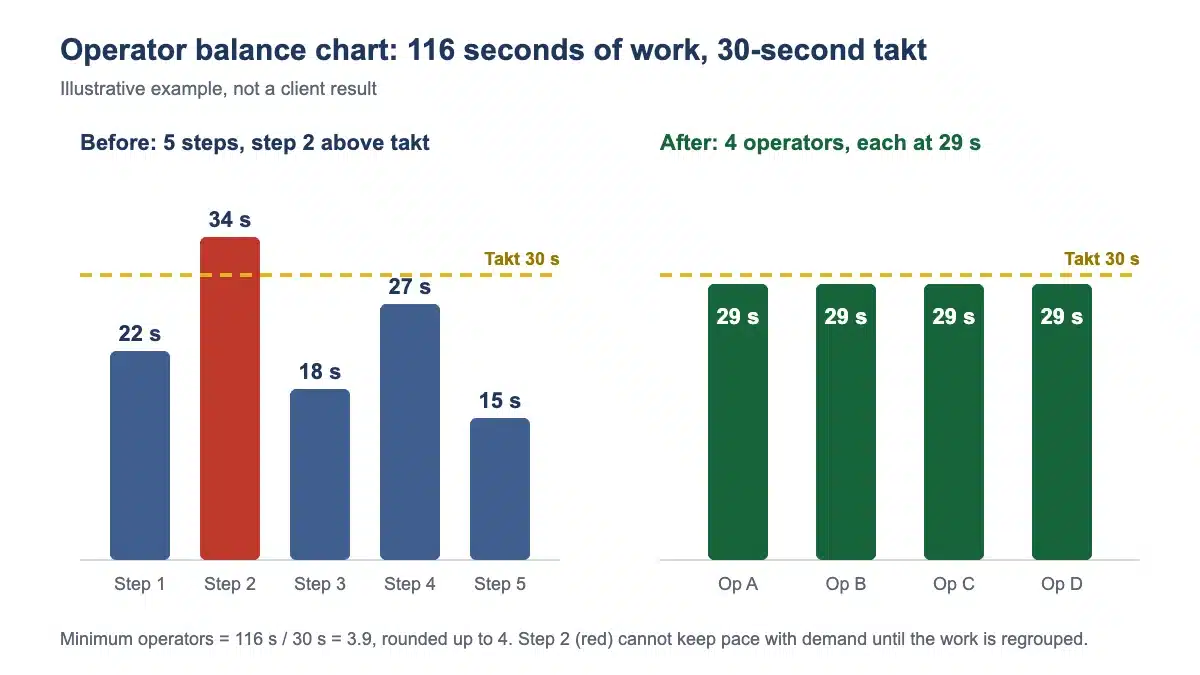
In the example, a first estimate of the operators needed is the total work content divided by takt time, rounded up: 116 ÷ 30 = 3.9, so 4 operators. The work elements are then regrouped so that each operator carries about 29 seconds, which means splitting the work inside steps rather than keeping the original step boundaries. The bottleneck disappears and nobody is loaded above takt.
Some manufacturers plan to a target cycle time a little below takt to allow for losses. For example, a Rolls-Royce guide on manning calculates target cycle time as takt multiplied by overall equipment effectiveness (OEE), and required manning as total basic time divided by that target cycle time. Whichever convention you use, write it down so everyone compares against the same number.
Speed up the bottleneck, not the fast steps
A line cannot finish units faster than its slowest step. In the example, step 2 at 34 seconds limits output to about 794 units a day. Cutting step 1 from 22 to 18 seconds would not add a single unit: step 1 would sit idle for longer, or build more inventory in front of step 2, which lengthens lead time. Spend improvement effort on the steps that are above takt, or closest to it, first.
Why plan below takt: variation
Measured cycle times vary from unit to unit. If a step's average cycle time equals takt, it will run slower than takt on some units, so work piles up in front of it and the line loses output it cannot easily recover. Queueing theory explains why: Kingman's formula estimates that the waiting time in front of a process grows with the variation in arrivals and processing times, and rises without limit as the process approaches 100% utilisation. Line balancing research makes the same point: variable task times can push station times past the cycle time. This is one reason to balance to a target a little below takt. The Rolls-Royce convention above sets that margin to allow for OEE losses (availability, performance and quality); a margin below takt also gives room for normal variation. Reducing the variation itself, through stable methods and standard work, lets you run closer to takt.
Limits on regrouping the work
The 4-operator answer assumes the work elements can be regrouped freely. On a real line they often cannot. Line balancing research names common limits: precedence relations (some tasks must be finished before others can start), tasks that need particular equipment or worker skills, and zoning restrictions on which tasks may share a station. The same Rolls-Royce guide adds practical rules: establish the order of the work by working backwards from the final operation, group work by machine or area where necessary (the guide gives this for non-cyclic work), match assignments to the skill each task needs, and let any partial loading fall on the last operator. Treat work content divided by takt as the minimum. If a fixed sequence, a machine or a skill requirement stops a clean split, you may need one more operator than the minimum, or a change to the method or layout to reach it.
Two more uses of takt are worth knowing:
- Pitch: takt time multiplied by the pack-out quantity. LEI's example is a 1-minute takt and 20 pieces per container, giving a pitch of 20 minutes: the time needed to make one container of products.
- Value stream mapping: a current-state map records cycle time at each process and lead time across the stream, and the future state is designed around takt.
Planning takt time in Malaysia
Available time depends on how many hours people can work. Under the Employment Act 1955 as amended in 2022, the Department of Labour Peninsular Malaysia (JTKSM) summarises maximum working hours in Peninsular Malaysia as 45 hours a week, in force from 1 January 2023. Sabah and Sarawak have their own labour ordinances. When you plan takt for a five- or six-day week, start from the normal hours your shifts are built on. Do not count overtime as available time: if the line needs overtime to meet demand every week, the capacity plan is short and the overtime is hiding it.
Recalculate takt whenever demand or the shift pattern changes. A customer forecast change, a second shift or a festive-season shutdown all move takt, and the line balance must follow.
MBizM Sdn. Bhd. is a registered HRD Corp training provider. Our Value Stream Mapping for Manufacturing course, which covers customer value and takt time and the value stream metrics of value-added time and lead time, is listed as HRD Corp claimable, subject to your employer's HRD Corp registration.
Common mistakes
- Treating takt as a speed target for people.Takt is the customer's pace. If a step cannot meet it, fix the method or the balance. Pushing people to work faster does not fix it.
- Subtracting unplanned downtime from available time.It shortens takt and builds the losses into the plan, so they stop looking like problems. Subtract only planned stops.
- Using standard times instead of measured cycle times.Routing-sheet times are often out of date. Time the real work over several cycles.
- Confusing cycle time with lead time.A line can have every step under takt and still have a lead time of days, because of the inventory waiting between steps.
- Not recalculating when demand changes.A takt time set last year for last year's demand balances the line to the wrong target.
- Balancing every operator to exactly takt.With normal variation in cycle times, a line loaded to 100% of takt will miss demand on some days. Balance to a target a little below takt.
FAQ
What is the formula for takt time?
Takt time equals available production time divided by customer demand for the same period. For example, 27,000 seconds of available time and demand of 900 units give a takt time of 30 seconds.
What is the difference between takt time and cycle time?
Takt time is calculated from customer demand and tells you how often one unit must be finished. Cycle time is measured at a step and tells you how long that step actually takes. Each step's cycle time should be at or slightly below takt.
What is the difference between lead time and cycle time?
Cycle time is the time one step takes to complete one unit. Lead time is the time one unit takes to pass through the whole process, including all the waiting between steps, so it is usually much longer than the sum of the cycle times.
What happens if cycle time is longer than takt time?
That step is a bottleneck: it cannot keep up with demand, so the line falls short or needs overtime. Rebalance the work across operators, remove waste from the step, or add capacity at that step.
How do you calculate the number of operators from takt time?
A first estimate is the total work content per unit divided by takt time, rounded up. With 116 seconds of work and a 30-second takt, you need 4 operators. Then regroup the work so each operator is loaded just below takt.
Key takeaway
Takt time is the customer's pace: available time divided by demand. Calculate it, and recalculate it when demand changes.
Cycle time is what each step really takes. Measure it, and keep every step at or just below takt.
Lead time is the whole journey, mostly waiting. Cut work in process to shorten it.
Lean training in Malaysia
Learn to design flow around takt time
Our Lean programmes are practical, tool-focused workshops. Value Stream Mapping for Manufacturing (2 days, HRD Corp claimable) covers takt time, value-added time and lead time, with simulation workshops. Courses run as public classes or in-house.
Training a whole line or plant team? See in-house training. Need help redesigning a line? See Lean Six Sigma consulting.
Related reading
Sources
- Lean Enterprise Institute. Takt time (Lean lexicon). Accessed 19 October 2026.
- Lean Enterprise Institute. Cycle time (Lean lexicon; includes machine cycle time, effective machine cycle time and production lead time). Accessed 19 October 2026.
- Lean Enterprise Institute. Operator balance chart (Lean lexicon). Accessed 19 October 2026.
- Lean Enterprise Institute. Pitch (Lean lexicon). Accessed 19 October 2026.
- Little, J. D. C. (2011). Little's law as viewed on its 50th anniversary. Operations Research, 59(3), 536 to 549. Reprint, Project Production Institute.
- Rolls-Royce (2020). How to determine optimal manning configuration, version 2. Value Chain Competitiveness.
- Jabatan Tenaga Kerja Semenanjung Malaysia (JTKSM). Employment Act (Amendment) 2022 summary. Accessed 19 October 2026.
- Kriengkorakot, N. and Pianthong, N. (2007). The assembly line balancing problem: review articles. Engineering and Applied Science Research, 34(2), 133 to 140.
- Roser, C. The Kingman formula: variation, utilization and lead time. AllAboutLean. Accessed 20 October 2026. Original: Kingman, J. F. C. (1961). The single server queue in heavy traffic. Mathematical Proceedings of the Cambridge Philosophical Society, 57(4), 902.
Start today
Learn Lean Six Sigma at your own pace
Each belt is a self-paced online course with quizzes and a certification exam. 12 months' access, start any day.
 Self-paced onlineLean Six Sigma Yellow BeltA first grounding in Lean, Six Sigma and DMAICStart any day · 12 months’ access · Certification exam includedRM2,088
 Self-paced onlinePopularLean Six Sigma Green BeltRun improvement projects with the core DMAIC toolsStart any day · 12 months’ access · Certification exam includedRM3,788
 Self-paced onlineBest sellerLean Six Sigma Black BeltLead larger projects with the full DMAIC toolkitStart any day · 12 months’ access · Certification exam includedRM5,088
Compare the three online courses · Self-paced courses are not HRD Corp claimable. For a claimable option, see live virtual courses.